
Modi government has taken some interesting policy decisions in the 100 days since the time he met President Pranab Mukherjee to present his claim as Prime Minister of the world's largest democracy, says Tanmaya Nanda.

'Does the government help ordinary citizens like you and me with our marriages, birthdays and anniversaries?' Rashme Sehgal reports on the controversy over the the Art Of Living Foundation's plans for a cultural festival on the Yamuna floodplains.
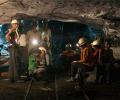
'Greenpeace has been brutal in targeting both India and the Manmohan Singh government. The push to go after Indian coal is driven by its long-term agenda. What is surprising is that China has not been meted out the same treatment, despite the fact that the rise of China as an economic power has been built around generating power from coal. 'Being richer and more affluent, yet far less democratic, there is less room for an NGO such as Greenpeace to drive home a complicated global agenda, so there is more of a tendency to go along with anything the Chinese offer despite China being the biggest by far with regard to coal use. But for India, it reserves tougher prescriptions, notably for its middle class, says Srinivas Bharadwaj.

30-year-old Krishnamurthy, founder, Honey Kart, quit his job as a technical programmer at Wipro, and borrowed money from friends to become a beekeeper. Today he is not only debt-free but also processes 500 kilograms of honey every month that sells for Rs 716 per kg.

Stretch. Make some calls. Or simply organise your desk.
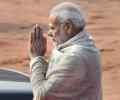
Prime Minister Narendra Modi on range of issues -- from Rafale deal to Ram temple and triple talaq.

'If a student can't get to school, the school will get to you. Even people with low reading abilities can be taught via videos.' 'Companies and students will be linked to their universities from the beginning and not towards the end of their course.' 'Digitalisation in education will be of enormous impact. Higher education must be closely linked to the demands on the future workforce.'
'If a student can't get to school, the school will get to you. Even people with low reading abilities can be taught via videos.' 'Companies and students will be linked to their universities from the beginning and not towards the end of their course.' 'Digitalisation in education will be of enormous impact. Higher education must be closely linked to the demands on the future workforce.'
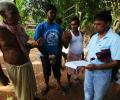
The farmers of Khentia are now working in tandem with the IIT team.

'Any new technology, either before or soon after its release, will face severe criticism by one or the other segment of society. It is only after seeing the benefits of new technology for themselves that our farmers accept it.' 'The arable land in India is not increasing and currently hovers at around 140, 145 million hectares.' 'Today, Indian agriculture has to work towards achieving nutritional security.'

With a plunge in steel prices, ship owners are getting about $3.6 million less for the 25,000 tonnes of recoverable metal.

'I cannot conceive of any reason than my unsparing criticism of government policies that the government picked me to send a message to many who dare to take it on.'

India is actively involved in reducing carbon emissions.

Here's a look at some of the hashtags that trended during the first year of the Modi regime.

All mankind looks for good news on a daily basis. It is only a natural human desire. Corporate managements, government spokespersons, political loyalists, merchants and salespersons, all work overtime to create good news. And governments, too, keep trying this with inane pronouncements all the time, says Raj Liberhan.
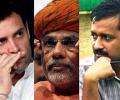
If Narendra Modi could tame his obsession with the Congress and the Nehru-Gandhi family, Arvind Kejriwal resist polishing his halo and Rahul Gandhi find his voice, we could begin a debate about the future of this country that actually addressed the seriousness of its problems, says Rahul Jacob.

India's nuclear establishment is continuing its march of folly at the expense of safety in the false belief that atomic power is the energy of the future. It's not. Nuclear power is in relentless global decline, says Praful Bidwai.

In a conversation with R Ramasubramanian, Xavier said, "My documentary attempts to find answers to those frequently asked questions from Tamil refugees who are still in India."

In our special series on A Day in the Life of India, Ashok Kumar Mondol, a Kolkata tram driver, speaks about the joys of driving a city institution.

PM Modi seems to be gradually ending India's strategic ambiguity

The president outlined the government's agenda in the coming financial year in his customary address to the joint sitting of both the Houses of Parliament.

The AAP has adopted policies in an ad hoc manner, without thinking them through or deriving them from a broader framework. This must change if the AAP is to become a credible alternative, says Praful Bidwai.
